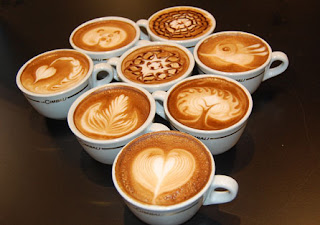
Do you ever find yourself standing at the counter at your
local coffee house pondering the difference between cappuccino and latte? Ever
wondered how this hugely popular specialty coffee industry got started? Let’s
take a look.

The terms caffè and latte were first used in 1847 and later
in 1867 they appeared in William Dean Howells essay "Italian
Journeys". Latte means milk in Italian and the caffè version of this drink
is an American invention. Caffè latte originated in Caffè Mediterraneum, a café
in Berkeley, California and was brewed in its current form by Lino Meiorin for
the first time. He added more milk to this otherwise strong cappuccino and
called this new drink "caffè latte".

Cappuccino, in commercial form, was introduced at the
beginning of 20th Century when the patented espresso machines were introduced
by Luigi Bezzera of Milan in 1901. These machines made the cappuccino very
popular in cafes and restaurants and the current form developed by the 1950s.
What, exactly, is a cappuccino? A cappuccino consists of 1/3
espresso, 1/3 milk and 1/3 foamed milk. The name, cappuccino, derives from the
Italian word, Capuchin, which means “small cap.” It is traditionally served in
Italy as a breakfast drink, but coffee aficionados now drink it any time of
day. A cappuccino should also traditionally be no more than 6 fluid ounces.
Coffee houses such as Starbucks serve “cappuccinos” in much larger sizes,
however. Often times these larger drinks simply contain more milk instead of additional
coffee, so that super grande may not be such a bargain after all. Variations of
the cappuccino include an iced version with no foamed milk called Cappuccino
Freddo and babyccino, a cappuccino with no coffee intended for small children.
Chocolate is often added.